Curcumin: What It Actually Does for Inflammation, Cholesterol, and More
Plant compound
Track the foods that fit your goals. Track it free with Ration →
Key takeaways
- Curcumin is the main active compound in turmeric, best known for its anti-inflammatory and antioxidant effects.
- Meta-analyses consistently show it lowers C-reactive protein and interleukin-6, two key markers of inflammation.
- Trials also link curcumin to modest reductions in triglycerides, with possible benefits for fatty liver and joint health.
- Poor natural absorption means most benefits in trials come from enhanced or high-dose formulations.
What is curcumin?
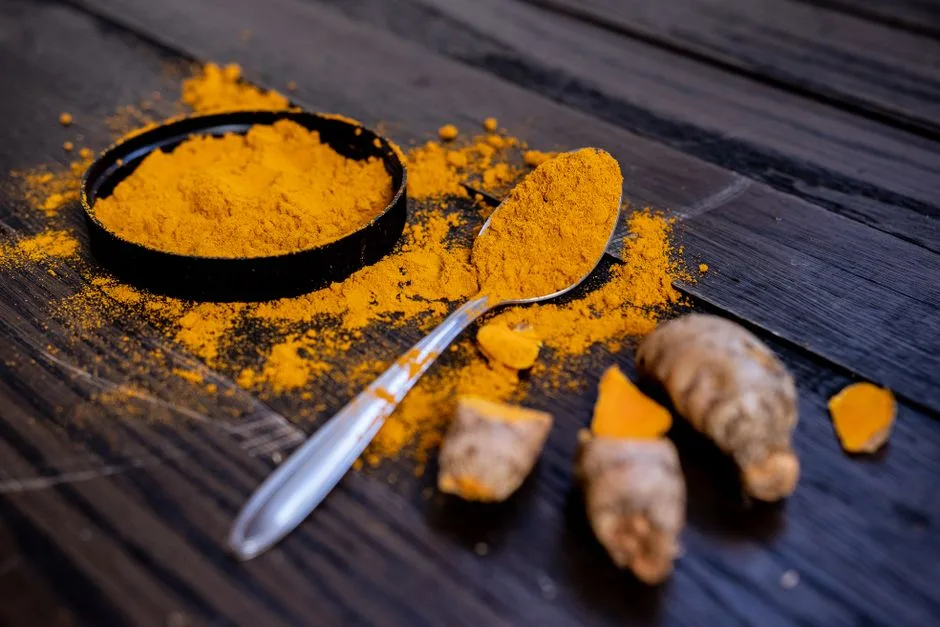
Curcumin is the yellow pigment found in turmeric, the spice derived from the Curcuma longa root.
It belongs to a class of plant compounds called curcuminoids.
People have used turmeric in cooking and traditional medicine for centuries, but curcumin itself only makes up a small percentage of the raw spice by weight.
This is one reason most research uses concentrated curcumin extracts or supplements rather than turmeric powder.
How does curcumin work in the body?
Curcumin is thought to act mainly through antioxidant and anti-inflammatory pathways.
Laboratory studies suggest it can dampen the activity of NF-kB, a protein complex that switches on many inflammatory genes.[11][12]
It also appears to reduce production of inflammatory signaling molecules like tumor necrosis factor-alpha and interleukin-6 in immune cells.[8][11][12]
Other cell studies point to effects on oxidative stress pathways involving ROS, CHOP, and HIF-1alpha, which are involved in how cells respond to stress and inflammation.[6]
In liver cells and animal models, curcumin has been studied for its influence on fat metabolism pathways like PI3K/AKT/mTOR, which may help explain its effects on liver fat.[5]
Curcumin is notoriously poorly absorbed on its own, which is why many supplements pair it with piperine (black pepper extract) or use special formulations like liposomal or phytosome curcumin to improve bioavailability.
Does curcumin reduce inflammation?
This is where curcumin has its strongest evidence base.
A dose-response meta-analysis of randomized controlled trials found that curcumin or turmeric supplementation meaningfully reduced markers of inflammation and oxidative stress in adults, with effects assessed as moderate to high certainty using GRADE criteria.[3]
A separate meta-analysis focused specifically on C-reactive protein (CRP) found consistent reductions across trials, reinforcing curcumin as one of the more reliably studied anti-inflammatory supplements.[7]
Interleukin-6 (IL-6) is another inflammatory marker that shows up repeatedly in curcumin research, both in cell studies and clinical trials.[8][11][12]
In people with rheumatoid arthritis, a joint condition driven heavily by inflammation, a systematic review and meta-analysis found curcumin supplementation was associated with improvements in disease activity and inflammatory markers.[4]
- TriglyceridesAHuman trials
Research may lower Triglycerides · strong agreement · 6 studies
View 5 studies on PubMed
- Effects of nutrition on metabolic and endocrine outcomes in women with polycystic ovary syndrome: an umbrella review of meta-analyses of randomized controlled trials (2023)
- Efficacy and safety of dietary polyphenol supplementation in the treatment of non-alcoholic fatty liver disease: A systematic review and meta-analysis (2022)
- The Effects of Curcumin on Diabetes Mellitus: A Systematic Review (2021)
- Curcumin supplementation alleviates hepatic fat content associated with modulation of gut microbiota-dependent bile acid metabolism in patients with nonalcoholic simple fatty liver disease: a randomized controlled trial (2024)
- Therapeutic roles of curcumin: lessons learned from clinical trials (2013)
- Interleukin-6AHuman trials
Research may lower Interleukin-6 · strong agreement · 6 studies
View 5 studies on PubMed
- Effect of curcumin on circulating interleukin-6 concentrations: A systematic review and meta-analysis of randomized controlled trials (2016)
- Antioxidant and anti-inflammatory effects of curcumin/turmeric supplementation in adults: A GRADE-assessed systematic review and dose-response meta-analysis of randomized controlled trials (2023)
- RI75, a curcumin analogue, inhibits tumor necrosis factor-α and interleukin-6 production and exhibits antiallodynic and antiedematogenic activities in mice (2022)
- Curcumin: An Effective Inhibitor of Interleukin-6 (2017)
- Curcumin suppresses interleukin-6 production in THP-1 monocytes induced by Propionibacterium acnes extracts via downregulation of Toll-like receptor 2 expression and the nuclear factor kappa B pathway (2019)
- C-Reactive ProteinAHuman trials
Research may lower C-Reactive Protein · strong agreement · 6 studies
View 5 studies on PubMed
- The Effects of Curcumin on Diabetes Mellitus: A Systematic Review (2021)
- Effect of curcumin on C-reactive protein as a biomarker of systemic inflammation: An updated meta-analysis of randomized controlled trials (2022)
- Antioxidant and anti-inflammatory effects of curcumin/turmeric supplementation in adults: A GRADE-assessed systematic review and dose-response meta-analysis of randomized controlled trials (2023)
- Effect of curcumin on rheumatoid arthritis: a systematic review and meta-analysis (2023)
- Endoplasmic Reticulum Stress Promotes the Expression of TNF-α in THP-1 Cells by Mechanisms Involving ROS/CHOP/HIF-1α and MAPK/NF-κB Pathways (2023)
Can curcumin help with liver fat and metabolic health?
Nonalcoholic fatty liver disease, now often called metabolic associated fatty liver disease, is an area of active curcumin research.
A randomized controlled trial in people with simple fatty liver found that curcumin supplementation reduced liver fat content, an effect the researchers linked to changes in gut microbiota and bile acid metabolism.[1]
A broader systematic review and meta-analysis of dietary polyphenols, including curcumin, found supportive evidence for improvements in liver fat and related markers in people with fatty liver disease.[9]
Combination research pairing curcumin with resveratrol has also explored effects on liver fat through pathways involved in fat storage and blood vessel formation, though this work is earlier stage and less directly applicable to typical supplement use.[5]
On the metabolic side, a systematic review looking at curcumin and diabetes mellitus found some favorable signals for blood sugar related markers, though the authors noted variability across trials.[10]
Curcumin has also been studied as part of broader nutrition strategies for polycystic ovary syndrome (PCOS), an umbrella review of meta-analyses, though it is just one of many nutrients examined in that context.[2]
Does curcumin lower triglycerides and cholesterol?
Trial data suggests curcumin supplementation is linked to reductions in triglycerides, a type of blood fat, with a body of evidence that our database grades as strong (grade A, based on 6 sources).
This effect may be connected to curcumin's broader influence on liver fat metabolism, given the overlap with fatty liver research.[1][5][9]
Effects on LDL cholesterol specifically are less consistently reported across the literature than the triglyceride findings.
What foods and supplements contain curcumin?
- Turmeric root, fresh or dried, used in curries and golden milk
- Turmeric powder, the most common culinary source, though low in curcumin by weight
- Standardized curcumin extracts, often listing 95% curcuminoids on the label
- Curcumin paired with piperine to improve absorption
- Liposomal or phytosome curcumin formulations designed for better bioavailability
How much curcumin do studies use?
Doses in clinical trials vary widely, often ranging from around 500 mg to 2,000 mg of curcumin per day, sometimes divided into multiple doses.[3][4][7]
Because absorption is so limited, the form matters as much as the amount. Studies using enhanced formulations often report using lower total doses to achieve similar blood levels compared with standard curcumin powder.
There is no established consensus dose, and study durations, forms, and co-ingredients differ enough that direct comparisons between trials can be difficult.
Is curcumin safe?
Curcumin is generally well tolerated in the doses used across clinical trials, with mild gastrointestinal upset being the most commonly reported issue.[3][4]
People taking blood thinners or with gallbladder issues are often advised to be cautious, since curcumin may affect bile flow and blood clotting in some contexts.
As with any supplement, quality and purity vary between products, and combination formulas with piperine or other compounds may carry their own interaction considerations.
This article is not medical advice, and anyone considering curcumin supplementation, especially alongside medications, should talk with a healthcare provider first.
Who might consider curcumin?
- People looking to support markers of inflammation like CRP and IL-6, based on trial evidence[3][7][11][12]
- People with rheumatoid arthritis exploring adjunct options alongside standard care[4]
- People with fatty liver disease interested in research-backed nutritional approaches[1][9]
- People with elevated triglycerides as part of broader metabolic health efforts
Bottom line
Curcumin has one of the more substantial evidence bases among popular supplements, particularly for lowering inflammatory markers like CRP and IL-6.[3][7][11][12]
Its effects on triglycerides and liver fat are promising but still an active area of research, with mechanisms not fully settled.[1][5][9]
Poor natural absorption remains the biggest practical hurdle, which is why formulation choice matters if someone is considering it.
Frequently asked questions
Does curcumin really reduce inflammation?
Multiple meta-analyses of randomized trials show curcumin supplementation lowers inflammatory markers like CRP and IL-6, making this one of its best-supported effects.[3][7]
Can curcumin help with fatty liver disease?
A randomized controlled trial found curcumin reduced liver fat content in people with simple fatty liver, and broader reviews of polyphenols support similar findings.[1][9]
Why is curcumin often paired with black pepper?
Curcumin is poorly absorbed on its own, and piperine, a compound in black pepper, is commonly used to help increase how much curcumin the body absorbs.
Does curcumin lower triglycerides?
Trial data grades this as a strong effect, with curcumin supplementation consistently linked to reductions in triglycerides across several studies.
Sources
- Curcumin supplementation alleviates hepatic fat content associated with modulation of gut microbiota-dependent bile acid metabolism in patients with nonalcoholic simple fatty liver disease: a randomized controlled trial · PMID 38795741
- Effects of nutrition on metabolic and endocrine outcomes in women with polycystic ovary syndrome: an umbrella review of meta-analyses of randomized controlled trials · PMID 36099162
- Antioxidant and anti-inflammatory effects of curcumin/turmeric supplementation in adults: A GRADE-assessed systematic review and dose-response meta-analysis of randomized controlled trials · PMID 36804260
- Effect of curcumin on rheumatoid arthritis: a systematic review and meta-analysis · PMID 37325651
- Advanced effect of curcumin and resveratrol on mitigating hepatic steatosis in metabolic associated fatty liver disease via the PI3K/AKT/mTOR and HIF-1/VEGF cascade · PMID 37544281
- Endoplasmic Reticulum Stress Promotes the Expression of TNF-α in THP-1 Cells by Mechanisms Involving ROS/CHOP/HIF-1α and MAPK/NF-κB Pathways · PMID 37894865
- Effect of curcumin on C-reactive protein as a biomarker of systemic inflammation: An updated meta-analysis of randomized controlled trials · PMID 34586711
- RI75, a curcumin analogue, inhibits tumor necrosis factor-α and interleukin-6 production and exhibits antiallodynic and antiedematogenic activities in mice · PMID 35094257
- Efficacy and safety of dietary polyphenol supplementation in the treatment of non-alcoholic fatty liver disease: A systematic review and meta-analysis · PMID 36159792
- The Effects of Curcumin on Diabetes Mellitus: A Systematic Review · PMID 34012421
- Curcumin suppresses interleukin-6 production in THP-1 monocytes induced by Propionibacterium acnes extracts via downregulation of Toll-like receptor 2 expression and the nuclear factor kappa B pathway · PMID 31209872
- Curcumin: An Effective Inhibitor of Interleukin-6 · PMID 27719643