Does Washing Broccoli Reduce Its Sulforaphane-Forming Potential?
Key takeaways
- Sulforaphane is not sitting in raw broccoli. It forms when an enzyme called myrosinase reacts with a compound called glucoraphanin.
- Myrosinase is water soluble and heat sensitive, so heavy rinsing, soaking, or hot water can wash it away or deactivate it before that reaction happens.
- A quick, cool rinse to remove dirt and residue is unlikely to destroy enough myrosinase to matter much, but soaking or blanching before chopping is riskier.
- Chopping or chewing raw broccoli after a gentle rinse still lets the myrosinase reaction happen, which the studies here link to Nrf2 pathway activation.
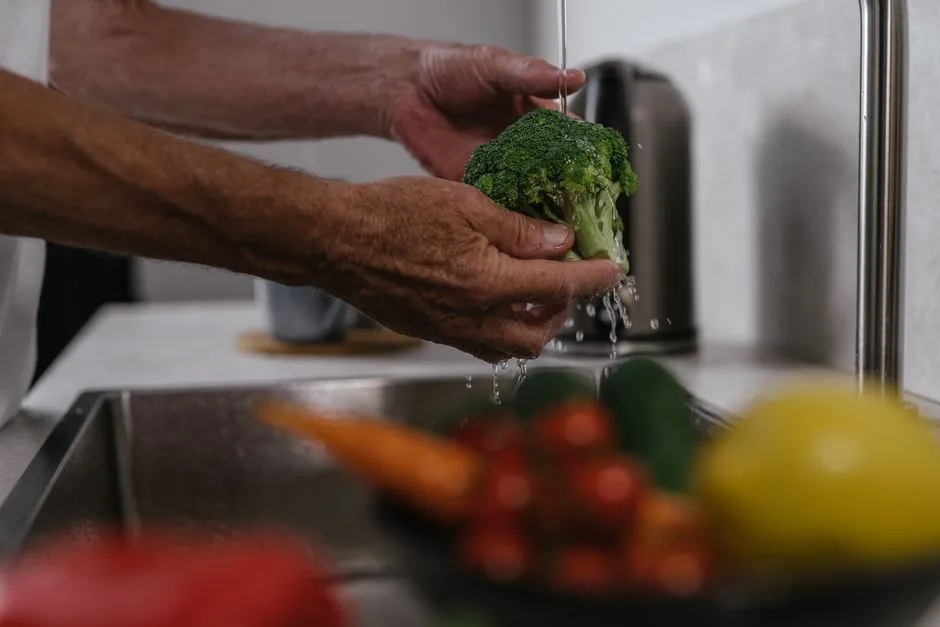
A quick, cool water rinse to remove dirt probably does not meaningfully reduce broccoli's sulforaphane-forming potential.
But soaking broccoli in water, or washing it with hot water, can wash away or deactivate the enzyme that makes sulforaphane form in the first place.
That enzyme is called myrosinase. It sits in the plant's cells, separate from a compound called glucoraphanin.
When you cut, chew, or otherwise damage raw broccoli, myrosinase and glucoraphanin mix together and react. That reaction is what actually makes sulforaphane.
Where does sulforaphane actually come from?
Broccoli does not contain sulforaphane on its own. It contains a precursor compound, glucoraphanin, stored in one part of the plant cell.
Myrosinase is stored in a different part of the cell. As long as the cell stays intact, the two never meet.
Cutting, chopping, chewing, or crushing broccoli breaks the cell walls.
That lets myrosinase reach glucoraphanin and convert it into sulforaphane, the compound researchers have studied for its role in activating a cell defense pathway called Nrf2[6][8][9].
Why washing could interfere
Myrosinase is a protein, and like most enzymes it is water soluble and sensitive to heat.
- Soaking broccoli in water can leach myrosinase out of the plant tissue before it ever gets the chance to react with glucoraphanin.
- Washing with hot or warm water can denature, or unfold and deactivate, the enzyme.
- Boiling or blanching broccoli for even a few minutes destroys most myrosinase activity, which is a separate but related issue from simple washing.
- A brief rinse under cool running water is far less likely to remove or deactivate enough myrosinase to matter.
Researchers studying sulforaphane consistently point out that how broccoli is prepared, not just how much of it you eat, changes how much sulforaphane actually forms[4][9].
This is described as a source versus dose question: the raw material for sulforaphane can be present, but preparation determines whether it converts.
Does rinsing before or after chopping matter?
Timing likely matters here, though this specific detail has not been directly tested in the studies available.
Rinsing broccoli whole, before cutting it, keeps the cell walls intact. The myrosinase stays sealed away from glucoraphanin during that rinse, so a quick cool wash beforehand should not interfere much.
Rinsing broccoli after it has already been chopped is a different situation.
At that point, myrosinase and glucoraphanin are already in contact and starting to react, or the enzyme is already exposed and soluble.
Running water over cut broccoli at this stage could wash away myrosinase before the reaction finishes.
A practical takeaway from the underlying chemistry is that washing broccoli whole, then cutting it and letting it sit for a few minutes before cooking, gives the myrosinase reaction time to happen with less disruption.
Does this actually change health effects?
The studies here focus heavily on what sulforaphane does once it is formed and absorbed, rather than on washing methods specifically.
- Sulforaphane has been studied for activating the Nrf2 pathway, which helps cells manage oxidative stress[2][5][7].
- Research has explored its potential relevance to chronic kidney disease[2], non-alcoholic fatty liver disease[5], obesity-related inflammation and insulin resistance[7], cancer biology[6], and neurological conditions[1][3].
- Reviews note that clinical results with sulforaphane have sometimes fallen short of expectations from lab studies, which may partly reflect inconsistent sulforaphane formation from food[9][11].
- Some researchers frame food sources rich in sulforaphane precursors as a low cost, or 'frugal', approach to activating Nrf2 compared with supplements[10].
None of these studies directly measured how washing technique affects sulforaphane yield in home kitchens. The connection here is based on established enzyme chemistry, not a controlled washing experiment.
Practical takeaways for washing broccoli
- Rinse broccoli briefly under cool running water rather than soaking it for a long time.
- Wash the head whole before cutting it, rather than washing it after chopping.
- Let chopped or crushed broccoli sit for a few minutes before cooking to give the myrosinase reaction time to occur.
- Avoid hot water rinses, since heat can deactivate myrosinase the same way cooking does.
- Remember that cooking method matters even more than washing. Boiling broccoli for several minutes reduces myrosinase activity far more than a quick rinse ever would.
Frequently asked questions
Does washing broccoli remove sulforaphane itself?
Not exactly, because raw broccoli does not contain much sulforaphane to begin with. Washing mainly affects myrosinase, the enzyme needed to form sulforaphane from glucoraphanin.
Is a quick rinse under the tap a problem?
Based on the enzyme chemistry involved, a short rinse under cool water is unlikely to remove or deactivate enough myrosinase to meaningfully change sulforaphane formation.
Does soaking broccoli in a bowl of water matter more?
Soaking gives water more time to leach the water soluble myrosinase enzyme out of the plant tissue, so it is a more plausible way for washing to reduce sulforaphane forming potential than a brief rinse.
Put this to work in your own food log. Track it free with Ration →
Sources
- Exploring sulforaphane as neurotherapeutic: targeting Nrf2-Keap & Nf-Kb pathway crosstalk in ASD · PMID 37249861
- Eat Your Broccoli: Oxidative Stress, NRF2, and Sulforaphane in Chronic Kidney Disease · PMID 33477669
- Emerging promise of sulforaphane-mediated Nrf2 signaling cascade against neurological disorders · PMID 31784171
- Broccoli or Sulforaphane: Is It the Source or Dose That Matters? · PMID 31590459
- Impact of Glucoraphanin-Mediated Activation of Nrf2 on Non-Alcoholic Fatty Liver Disease with a Focus on Mitochondrial Dysfunction · PMID 31775341
- Nrf2 targeting by sulforaphane: A potential therapy for cancer treatment · PMID 28001083
- Glucoraphanin: a broccoli sprout extract that ameliorates obesity-induced inflammation and insulin resistance · PMID 29898626
- KEAP1 and Done? Targeting the NRF2 Pathway with Sulforaphane · PMID 29242678
- Sulforaphane and Other Nutrigenomic Nrf2 Activators: Can the Clinician's Expectation Be Matched by the Reality? · PMID 26881038
- Frugal chemoprevention: targeting Nrf2 with foods rich in sulforaphane · PMID 26970133
- Sulforaphane: translational research from laboratory bench to clinic · PMID 24147970